Extreme Heat and Shrinking Diurnal Temperature Range



Design and data visualizations for a scientific report highlighting global changes in the character and frequency of air masses linked to extreme heat events.

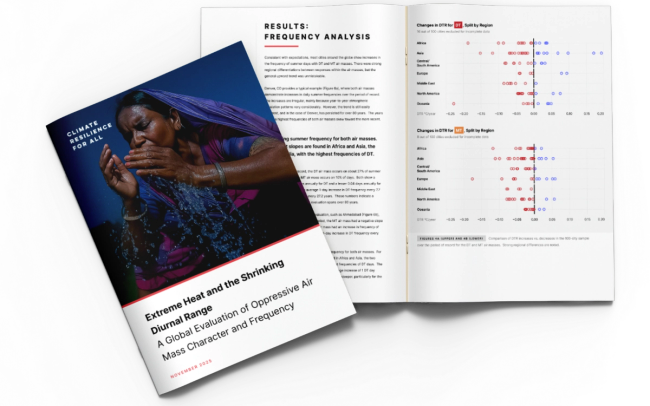
We partnered with Climate Resilience for All to design a report presenting new research on dangerous summer air masses and how they are changing worldwide. The study, led by a team of climate scientists, found that nighttime temperatures during extreme heat events are rising far faster than daytime temperature — a critical but underreported dimension of climate change with serious public health implications.
The project involved close collaboration with the researchers to translate complex meteorological data into clear, compelling visuals. We worked iteratively to determine the most appropriate visual treatment and how best to represent trends across 100 cities, multiple climate zones, and 30 years of data.
We used Observable notebooks to quickly prototype the visualizations, allowing us to use real data to quickly explore different approaches and bounce ideas off of the research team before moving on to final design and polish.


Beyond the visualizations, we designed all aspects of the full presentation — cover, layout, and typographic hierarchy — resulting in a 27 page report helping to ensure the research reaches policymakers, public health officials, and climate practitioners.
Decimal Point
1417 NW 54th St
Suite 372
Seattle, WA 98117
info@decimalpoint.studio